Routine Support Exposes Deeper System Problems
User issues repeatedly trace back to identity, applications, devices, networks, integrations, infrastructure, data, access, or vendor decisions that ordinary ticket handling cannot resolve.
Give the technology environment one accountable operating model without requiring business leadership to coordinate every technical discipline.
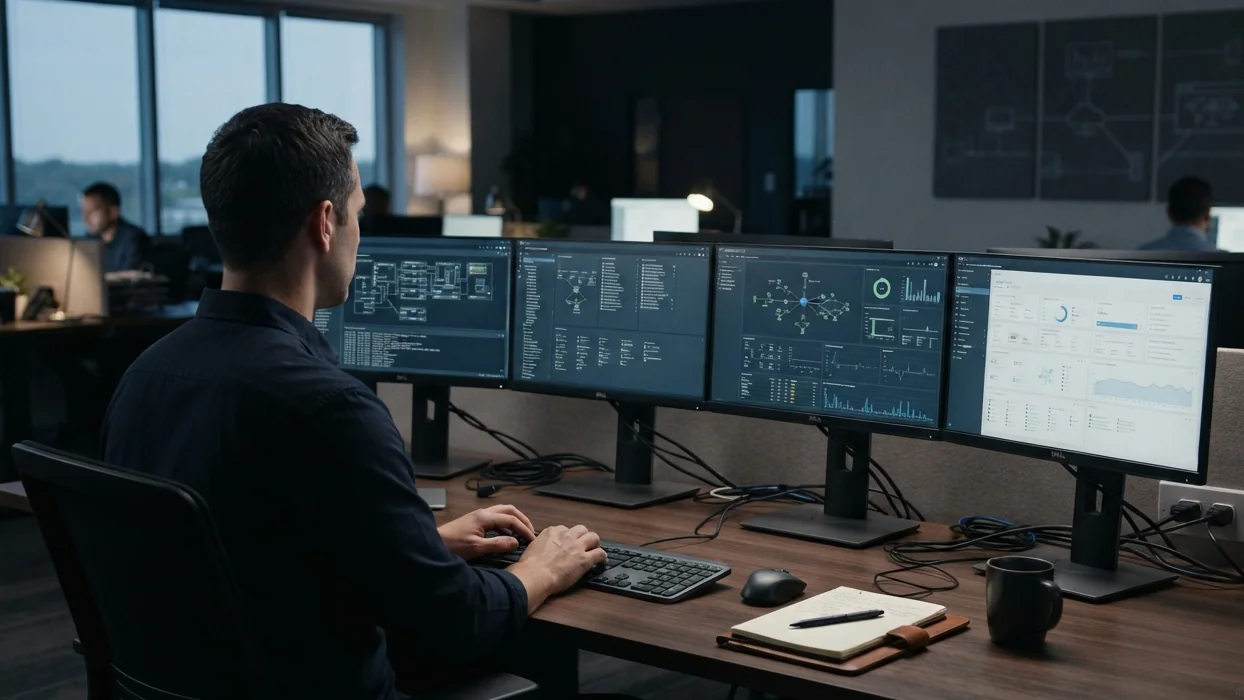
The individual services may appear covered while the complete operating outcome remains unowned. Problems then move between help desk, vendors, application teams, infrastructure, security, and leadership.
User issues repeatedly trace back to identity, applications, devices, networks, integrations, infrastructure, data, access, or vendor decisions that ordinary ticket handling cannot resolve.
Each provider controls one layer, but incidents, changes, security, recovery, and planning cross those boundaries and return to leadership for coordination.
Leadership spends time translating priorities, rebuilding context, resolving ownership disputes, and supervising technical work that should operate under an established authority.
The desired outcome is a defined technical function in which routine operations, specialized engineering, security, continuity, vendor participation, and improvement share the same operating context.
The managed scope identifies which systems, standards, access, decisions, vendors, service expectations, and operating outcomes are under the accountable boundary.
Issues can move from user support into application, infrastructure, platform, data, identity, security, or recovery engineering without losing context.
Incident patterns, support demand, lifecycle risk, capacity, recovery findings, and security needs feed a prioritized operating and engineering backlog.
Managed responsibility is earned and bounded. Work can begin with one environment or operating concern and expand as access, standards, context, and authority are established.
Establish the users, devices, identity, applications, data, infrastructure, networks, providers, support paths, security controls, recovery obligations, and current decision owners.
Agree which responsibilities, systems, service expectations, standards, access rights, escalation paths, and decisions can be accepted under managed ownership.
Address the support, access, infrastructure, application, backup, recovery, security, lifecycle, or documentation gaps creating the greatest operational exposure.
Run daily operations, measure recurring demand and failure, maintain the environment, and direct engineering effort toward the next material constraint or risk.
Existing employees, providers, and specialists can remain involved, but accountability cannot depend on indefinite coordination beneath another technical authority.
Appropriate when identity, devices, collaboration, networks, support, onboarding, lifecycle, and security controls need consistent daily ownership.
Appropriate when business applications, databases, integrations, production platforms, releases, observability, and recovery require continuing engineering responsibility.
Appropriate when cloud, private, hybrid, dedicated, network, storage, backup, recovery, and capacity decisions need an accountable operator.
Appropriate after the context and authority exist to connect daily support, engineering, data, infrastructure, security, vendors, continuity, and improvement under one model.
Technology operations may draw from user support, infrastructure, application engineering, platform operations, data management, security, backup, and recovery according to the defined boundary.
Managed operations across users, identity, applications, infrastructure, data, support, and engineering under clear technical authority.
Workload-led architecture and operation across public, private, hybrid, dedicated, bare-metal, and edge infrastructure.
Backup monitoring, replication, retention, recovery planning, recovery testing, and continuity management for critical systems and data.
Security assessment, endpoint and access protection, vulnerability management, incident readiness, remediation, and compliance control support.
Production ownership across CI/CD, infrastructure as code, isolated environments, orchestration, messaging, observability, performance, capacity, and recovery.
Traditional managed IT commonly focuses on users, devices, identity, networks, and standard infrastructure. Technology operations can include those responsibilities while extending the operating boundary into custom applications, production platforms, data systems, integrations, recovery, and engineering improvement.
Yes. Internal teams can retain business, product, domain, or defined technical responsibilities. The important requirement is that ownership, decision authority, access, escalation, and operating expectations are explicit rather than shared ambiguously.
Yes, where their role is useful and their responsibility can be incorporated into a clear operating model. Vendor participation does not remove the need to define who owns cross-system decisions, incidents, standards, and outcomes.
Security maintenance, access control, monitoring, backup, restoration testing, incident readiness, continuity, and recovery planning can be included when they fall within the agreed scope. Exact obligations and coverage must be established explicitly.
Yes. A relationship may begin with one system or operating responsibility and expand after the environment is understood and the authority, access, standards, and service expectations required for broader accountability are established.
Start with the environment, recurring operating burden, existing providers, and the decisions that currently return to leadership.